

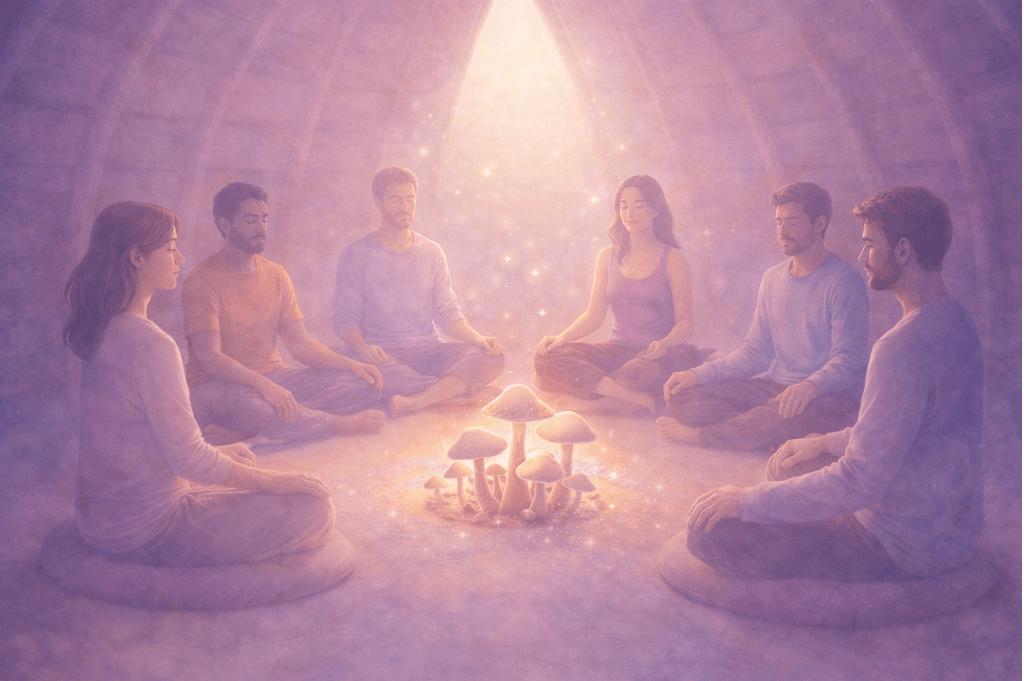
If you’ve arrived here, something in you is already listening. Maybe you’re navigating a transition. Maybe conventional paths have taken you as far as they can. Maybe you simply sense that there is more to understand, to release, to become.
Psilocybin retreats have moved from the margins into the mainstream conversation, and with that comes a great deal of noise. Legal questions. Safety concerns. Competing claims. This article cuts through the confusion and gives you what you actually need: honest, grounded information so you can make a decision that feels right for where you are right now.
After reading this, you’ll know whether a psilocybin retreat is the right next step and how to approach it responsibly.
In a Nutshell
- The Netherlands is the only European country with a clear legal framework for guided psilocybin retreats, using psilocybin-containing truffles
- Professional retreats follow a structured three-day format: preparation, guided ceremony, and integration
- Psilocybin is one of several plant medicine traditions, alongside ayahuasca and san pedro, but stands out for its legal accessibility in Europe
- Thorough medical and psychological screening is essential before attending any retreat
- Integration after the retreat is where lasting transformation actually takes root
- Cost typically ranges from €800 to €1,500 for a three-day program including accommodation, meals, and support
Where Are Psilocybin Retreats Legal in Europe?
The legal landscape across Europe is uneven, and understanding it matters for both your safety and your peace of mind.
The Netherlands: Europe’s Hub for Legal Retreats
While psilocybin mushrooms were prohibited in the Netherlands in 2008, psilocybin-containing truffles (the underground part of the same organism, carrying the same active compound) remain fully legal to possess, sell, and consume. This distinction has allowed retreat centers to operate openly within Dutch law, with professional facilitators, proper insurance, and transparent practices. The Dutch approach has always emphasized harm reduction and responsible use.
Other European Countries: What You Need to Know
Portugal is often mentioned in the same breath as the Netherlands, but the distinction matters. Portugal decriminalized personal possession of all substances in 2001, meaning individuals won’t face criminal charges for small amounts. But decriminalization is not legalization. There is no legal framework for retreat centers to operate openly, purchase psilocybin legally, or advertise their services.
Spain and the Czech Republic have relatively liberal drug policies but neither has created a clear legal pathway for commercial retreat operations. Germany, France, the UK, and most of Scandinavia maintain strict prohibitions in all forms.
For anyone prioritizing safety, professional guidance, and legal clarity, the Netherlands remains the only reliable option for psilocybin retreats in Europe.
Psilocybin vs. Other Plant Medicines
If you’ve been researching plant medicine traditions, you’ve likely encountered ayahuasca and san pedro alongside psilocybin. Each has deep roots in traditional healing practices. Each offers its own texture of experience. And each carries a different legal reality in Europe.
Ayahuasca is a brew made from Amazonian plants, used in South American shamanic traditions for centuries. Ceremonies are typically conducted overnight and last six to eight hours, with a strong purging component that many describe as physically intense but deeply cathartic. In Europe, ayahuasca exists in a legal gray area, technically illegal in most countries, though some religious organizations operate under protected status. Finding a genuinely safe and legal ayahuasca retreat in Europe is considerably more difficult.
San pedro (huachuma) is a cactus-based medicine from the Andean traditions of Peru and Ecuador. Its primary compound, mescaline, produces a longer and often gentler experience; ceremonies can last ten to twelve hours. Like ayahuasca, san pedro is illegal in most European countries and operates without a clear legal framework on the continent.
Psilocybin truffles, by contrast, are entirely legal in the Netherlands. For Europeans seeking a structured, safe, and legally clear psychedelic experience with professional facilitation, psilocybin retreats are by far the most accessible option, without the need to travel to South America or navigate legal uncertainty.
| Psilocybin (NL) | Ayahuasca | San Pedro | |
|---|---|---|---|
| Legal in Europe | Yes, Netherlands | Gray area / mostly illegal | Illegal in most countries |
| Duration | 4 to 6 hours | 6 to 8 hours | 10 to 12 hours |
| Physical intensity | Moderate | High, purging common | Moderate to high |
| Professional guidance | Yes, structured retreats | Very limited legal options | Very limited legal options |
What Happens During a Psilocybin Retreat?
Professional retreat programs in the Netherlands follow a carefully designed three-day arc. This structure reflects decades of wisdom from both traditional psychedelic practice and modern psychological approaches to personal transformation.
Day 1: Preparation and Intention Setting
The first day focuses entirely on preparation. You arrive at the retreat center, meet the facilitators and other participants, and begin creating the safe, supportive container that will hold everyone through the ceremony.
Breathwork, gentle movement, and guided meditation help you drop out of your thinking mind and into your body. Intention setting is a central practice, not rigid goal-setting, but approaching the experience with openness and curiosity. Facilitators guide you through reflection exercises and journaling prompts that help clarify what you’re bringing to the journey without grasping for specific outcomes.
Day 2: The Guided Psilocybin Ceremony
The ceremony day is the heart of the retreat. You begin early, often around 8 or 9 AM, giving you the full day to journey. The ceremony space is intentionally designed to support inner exploration: comfortable mattresses, blankets, low lighting, and thoughtfully curated music.
Dosage is carefully calculated based on body weight, experience level, and individual sensitivity. Effects begin within 30 to 45 minutes. You’ll be invited to lie down, put on an eye mask, and let the music help guide the journey. Facilitators hold space and provide support when needed. They don’t lead your experience or interpret your journey. They trust the wisdom of the medicine and your own inner guidance.
What you experience during these four to six hours is deeply personal. Some people encounter profound emotional release: grief, fear, or held pain that has waited years for space. Others experience vivid clarity about relationships, direction, or purpose. Difficult moments happen too, and skilled facilitators are trained to help you move through them rather than around them. Often, those moments hold the most.
Day 3: Integration and Grounding
The third day shifts focus to integration, making sense of your experience and translating insights into everyday life. This is where the life-changing potential of the retreat either takes root or fades. Without this step, even profound insights can dissipate within weeks.
Sharing circles allow each participant to speak about their experience while others listen without judgment. Facilitators help you identify key themes and explore concrete ways to honor your insights once you return home. You leave with integration workbooks, journaling prompts, and clear guidance for continuing the work.
How to Choose a Safe and Professional Retreat
As legal psychedelic retreats have grown in visibility, so has the variation in quality, safety standards, and facilitator training. Here is what actually matters when choosing a provider.
- Facilitator qualifications. Look for backgrounds in mental healthcare, psychology, or social work combined with specialized psychedelic facilitation training. Ask how many retreats they’ve facilitated and what support systems exist for challenging experiences.
- Thorough screening. Reputable centers conduct detailed medical and psychological screenings before accepting participants. If a retreat accepts you without asking substantive health questions, that is a significant warning sign.
- Group size and ratios. Retreats with more than 12 to 15 participants often can’t provide adequate individual attention during ceremony. A good facilitator-to-participant ratio is 1:4 to 1:6.
- Legal compliance. Verify the center operates within Dutch law using legal psilocybin truffles. Ask where truffles are sourced and whether the center has proper permits and insurance.
- Integration as a priority. A retreat that ends when you leave the center is unlikely to support lasting change. Look for programs that offer follow-up calls, integration resources, and ongoing support after the retreat ends.
- Transparent communication. Good providers tell you exactly what to expect, what’s included, and what they cannot guarantee. They answer your questions honestly, including the difficult ones.
Who Should Attend a Psilocybin Retreat?
A psilocybin retreat is not for everyone, and honest self-assessment matters more than enthusiasm.
Who Benefits Most
The ideal retreat participant is a mentally and physically healthy adult seeking deeper self-understanding, personal growth, or spiritual exploration. People who tend to find this deeply valuable include:
- Those navigating significant life transitions: career changes, relationship endings, loss, or major decisions
- Professionals experiencing burnout who want to reconnect with a deeper sense of purpose
- Spiritual seekers drawn to questions about consciousness, meaning, and connection
- People stuck in limiting beliefs or emotional patterns who want a new perspective
- Individuals whose traditional therapy has plateaued and who are looking for a catalyst for deeper change
When a Retreat May Not Be Right for You
A psilocybin retreat is not appropriate if you have:
- Active psychosis, schizophrenia, or a personal or family history of these conditions
- Bipolar disorder Type 1
- Severe, untreated depression or active suicidal ideation
- Significant recent trauma without adequate therapeutic support
- Medications such as SSRIs, MAOIs, or lithium (requires supervised tapering; never stop without medical guidance)
- Significant cardiovascular conditions, uncontrolled high blood pressure, or seizure disorders
- Pregnancy or breastfeeding
Always complete a thorough screening with your retreat provider before attending. A reputable provider’s intake process exists to ensure your safety, not to create barriers.
Psilocybin Retreats vs. Other Personal Development Options
A psychedelic retreat is one path among many. Understanding where it sits helps you choose what genuinely fits where you are right now.
| Option | Best for | Duration | Cost range |
|---|---|---|---|
| Psilocybin retreat | Deep transformation, breaking through stuck patterns | 3 days + integration | €800 to 1,500 |
| Traditional therapy | Long-term processing, sustained support | Ongoing, months to years | €80 to 150/session |
| Meditation retreat | Mindfulness, stress reduction, inner stillness | 3 to 10 days | €300 to 800 |
| Coaching | Goal-setting, accountability, action planning | 3 to 6 months | €1,000 to 3,000 |
| Breathwork retreat | Somatic release, emotional processing | 1 to 3 days | €400 to 900 |
The key differentiator of a psilocybin retreat is its capacity to catalyze months of therapeutic progress in a condensed timeframe. The psychedelic state temporarily dissolves the rigid mental structures and defense mechanisms that normally keep us from seeing ourselves clearly, creating breakthrough moments that might take years to reach through talk therapy alone.
These paths are not in competition. The most effective approach for many people combines regular therapy or coaching with occasional psilocybin retreats when they’re ready for deeper work. The ceremony opens a door. Integration is how you walk through it.
Ready to Take the Next Step?
If you’re drawn to a legal psilocybin retreat that combines professional facilitation, psychological safety, and genuine integration support, Essence Institute has been guiding participants through transformative experiences in the Netherlands since 2019. Every program is led by mental healthcare professionals and experienced guides, in small groups with real individual attention.
Frequently Asked Questions About Psilocybin Retreats in Europe
Are psilocybin retreats in Europe legal?
Yes, but only in specific contexts. In the Netherlands, psilocybin-containing truffles are legal and can be used in guided retreat settings. This makes the Netherlands the only European country with a clear legal framework for this kind of experience. Always verify that your chosen retreat operates within Dutch law.
What is the difference between psilocybin truffles and mushrooms?
Truffles are the underground part of the same organism that produces psilocybin mushrooms. They contain the same active compound and produce the same effects. The distinction matters legally: mushrooms were banned in the Netherlands in 2008; truffles were not.
Is a psilocybin retreat safe?
When facilitated by trained professionals with proper screening, psilocybin retreats are generally safe for healthy adults. Safety depends on both professional guidance and individual suitability, which is exactly why screening matters. If a provider doesn’t ask careful questions about your health, look elsewhere.
What if I have a difficult experience during the ceremony?
Challenging experiences can happen, and they are often where the most meaningful breakthroughs occur. In a supported retreat environment, professional facilitators are specifically trained to help participants navigate uncomfortable emotions rather than bypass them. Set and setting play a significant role, which is why preparation is treated as seriously as the ceremony itself.
Do I need previous experience with psychedelics?
No. Many retreat participants are first-time users, and reputable programs are designed to support people regardless of experience level. What matters more than prior experience is genuine readiness: a willingness to approach the journey with openness, respect, and an honest intention to look inward.
How is psilocybin different from ayahuasca or san pedro?
All three are plant medicines with long histories of ceremonial use, but they differ in duration, physical intensity, and legal status. Psilocybin truffles are the only option that is fully legal and professionally accessible in Europe. For most people seeking a safe, guided experience on the continent, psilocybin is the clearest path.